Precondition or not, that is the question
Posted on October 30, 2025 by The Ohio State University
Source: Farm Progress. The original article is posted here.

By Dr. John Yost, Extension Educator, Agriculture and Natural Resources, Wayne County, Ohio State University Extension
I have mixed feelings about social media, but I must admit that I have profiles on several platforms. My feeds mostly contain posts from various livestock related pages and I enjoy reading some of the opinions and questions. Recently, a post caught my eye. Someone had raised the question of whether it was worth the effort this year to pre-condition their calves. As an educator, my initial reaction was, “Of course you want to pre-condition your calves!” However, after a little reflection, I was able to understand someone questioning what might be their traditional management practices.
Cattle prices are crazy. Marketing cattle is almost as easy as one of those “drive it, tow it, drag it” used car deals that are advertised from time to time. The market is hungry for cattle and buyers may be willing to compromise their standards to fill their needs. It is easier to understand why someone would reconsider the added expense and time to keep calves around an extra 45 days and choose to mitigate their risk by weaning calves on the truck to the stockyards.
There is no doubt that the beef industry needs producers to pre-condition calves before they move on to the next production stage, and there have been premiums available for those producers who were willing to accept that risk. In September of 2023, a team of researchers, led by Dr. Darrel Peel from Oklahoma State University, published a research report titled “Value Indicators in Feeder Cattle: An Analysis of Multi-State Auction Data”. The project evaluated the relationship of animal characteristics and producer management practices on the cash value of feeder cattle. You can read the full paper at https://www.ams.usda.gov/sites/default/files/media/ValueIndicatorsinFeederCattleAuctionData.pdf .
Related: Partnerships strengthen the beef industry
In their analysis of auction market prices, the team found that cattle buyers were paying premiums for cattle that had been preconditioned. Specifically, they identified that bull calves were valued $7.39/cwt lower, on average, than steers. Calves weaned 30 days or more ($4.48/cwt), vaccinated ($1.97), and dehorned or polled ($8.47/cwt) were all valued higher than their contemporaries that had not been managed the same. As we look back over the last 12 years, the added value of pre-conditioning has fluctuated between an average premium of $8.68 to $23.36/cwt (Figure below).
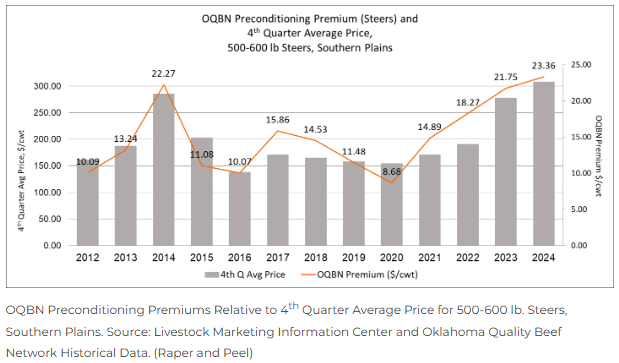
We are still left to wonder if buyers will reward producers as the markets continue to inch higher. As chance would have it, as I was writing this column, I received a notification that I had received an email with my Drovers daily newsletter. The top article was from Kellie Raper, Oklahoma State University Livestock Marketing Specialist, and it discussed this very issue. Kellie referenced the same chart (Figure 1) with yearly premium values reported. She pointed out that during the same 12-year period, the premium values moved with the market price. She pointed out that producers in the Southern Plain had been dealing with drought conditions from 2012 to 2015. In 2014, market prices increased substantially, and premium values followed suit. It is Dr. Raper’s opinion that there will be premiums to be found for preconditioned cattle.
Related: Understanding and mitigating cattle methane emissions
Why could buyers be willing to pay more for preconditioned cattle in high market price conditions? The answer is simple: risk management. The buyers are investing significantly to acquire the cattle they need, and it makes sense that they would reward producers for accepting some of their risk. Research has shown that preconditioned calves have lower morbidity and mortality rates, resulting in lower health treatment costs, and greater average dry matter intakes and average daily gains for feedlot operators. While the benefit to the next owner of your calves is obvious, preconditioning may still not be the best decision for each cow-calf producer.
Related: October is a wrap
The cost to precondition a calf will vary from operation to operation. Each producer needs to evaluate their available resources and have an understanding of what their true opportunity cost can be. Direct costs associated with hay, grain, vaccination programs, and castration are obvious. However, indirect costs are often overlooked. You also need to factor in costs for equipment, interest, your labor, and depreciation. I recommend that you take advantage of OSU Extension’s Enterprise Budgets ( https://farmoffice.osu.edu ). Oklahoma State University also offers a preconditioning budget calculator ( https://extension.okstate.edu/programs/beef-extension/calculators .
If you decide that preconditioning will work for you, what practices should you consider? The American Angus, American-International Charolais, American Hereford, and the Red Angus associations, as well as the major pharmaceutical companies, all offer branded preconditioning programs. Standard conditioning programs consist of:


Clark County Feeders is a BQA Certified 655-acre feed yard and grain storage facility specializing in beef cattle custom feeding and grain purchase, storage and sales.
.jpg?disable=upscale&width=1200&height=630&fit=crop)